
- calendar_today August 7, 2025
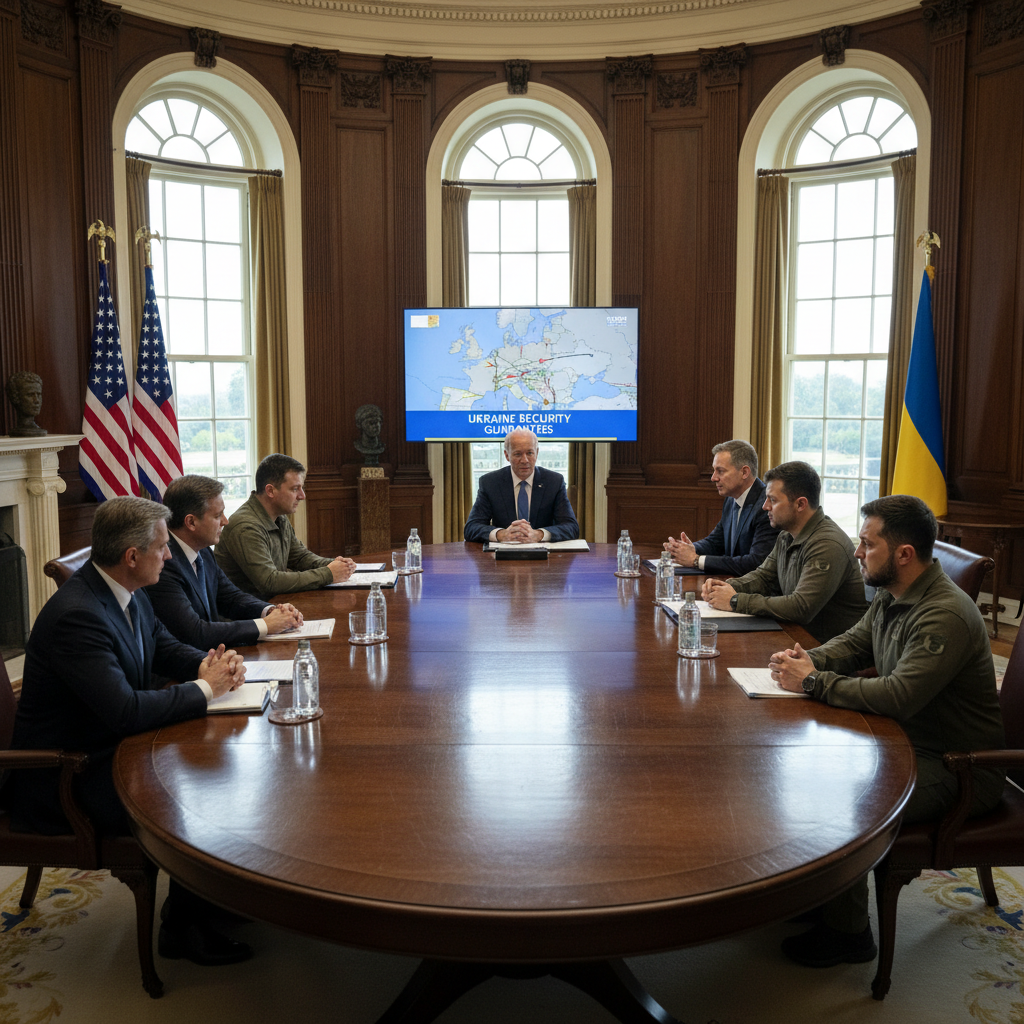
Ukrainian President Volodymyr Zelenskyy spoke with U.S. President Donald Trump on Monday about security guarantees for Ukraine, as the war with Russia heads into its fourth year.
“The conversation was good. The first one is security guarantees. And we are very happy with President [Trump], that all the leaders are here, and security in Ukraine depends on the United States and European countries,” Zelenskyy said at the White House alongside Trump and European leaders. Zelenskyy added that Washington’s readiness to extend strong signals of support was “very important.” However, he did not explain what the proposed guarantees would include.
Trump stressed the importance of security but also said Europe needs to do more to help Ukraine. He also said that the conflict cannot be solved without difficult discussions about territory. “We’re going to help them, and we’re going to make it very secure,” Trump said. “We also need to discuss the possible exchanges of territory, taking into consideration the current line of contact. That means the war zone, the war line center.”
The White House meeting with Zelenskyy revealed deep divisions among Western leaders over the issue of balancing support for Ukraine with a push for negotiated peace. Trump is far more open to territorial concessions, whereas Zelenskyy has repeatedly said Ukraine will not give up its sovereignty or international borders.
Calls for Sanctions, Ceasefire Debate, NATO Question
As the leaders in Washington were discussing guarantees, U.S. lawmakers were ratcheting up the calls for sanctions on Russia and its trading partners. Senator Lindsey Graham, R-S.C., said on Monday that the Trump administration should be moving much more aggressively against Moscow’s finances by going after the nations that continue to purchase Russian oil. He is co-sponsoring a bill that would allow Trump to impose tariffs of up to 500 percent on countries doing business with Russia.
“My advice to President Trump and [Secretary of State Marco Rubio] is, you’ve got to convince Putin that if this war doesn’t end justly and honorably with Ukraine making concessions also, we’re going to destroy the Russian economy,” Graham said on Fox News. “The second most important person on the planet to end this war is President Xi in China,” he added. Graham said it was time for Washington to pressure Beijing to lean on Putin.
Trump has already demonstrated his willingness to use tariffs as a threat. In August, Trump announced a 50 percent tariff on India in part due to its purchase of Russian oil. Graham suggested a similar move could be used to target China.
In Europe, the European Union is working on its 19th sanctions package against Russia. The new EU sanctions, which could be in place later this month, will have the stated aim of further weakening Moscow’s energy revenues, access to European banking, and military-industrial base. They will also close loopholes that have allowed entities to move assets around to evade sanctions. After nearly four years of coordinated Western action against Moscow, Russia is now the most sanctioned country in modern history, more economically isolated than Iran, North Korea, or Venezuela.
Sanctions, however, are not the only point of contention. European leaders also pressed Trump on the need for a ceasefire before any serious negotiations can take place. German Chancellor Friedrich Merz pushed back against the idea that Ukraine should disarm before talks, saying that a temporary truce is necessary to give negotiations credibility. “I can’t imagine that the next meeting would take place without a ceasefire,” Merz said. Trump rejected this argument, pointing to several of the six peace agreements he says he has brokered in recent months, which were done without a ceasefire. “You have a ceasefire, and they rebuild and rebuild and rebuild,” Trump said, while also conceding the main advantage of a truce would be an immediate stop to civilian deaths.
Finnish President Alexander Stubb, who was elected in March 2024, also took part in the White House talks. Stubb has been openly critical of Russian President Vladimir Putin’s willingness to observe any ceasefire and said he did not expect Moscow to adhere to it. Stubb, who is seen as one of Trump’s closest European interlocutors, said that Finland’s long history with Russia and 800-mile border shaped his worldview. “If I look at the silver lining of where we stand right now, we found a solution in 1944, and I’m sure that we’ll be able to find a solution in 2025 to end Russia’s war of aggression,” Stubb said.
Beyond sanctions and ceasefires, Trump has also been blunt about what he would like to see as part of the end to the war. In a post on Truth Social, Trump urged Kyiv to formally give up Crimea, which Russia annexed in 2014, and to abandon its desire to join NATO. “President Zelenskyy of Ukraine can end the war with Russia almost immediately, if he wants to, or he can continue to fight,” Trump wrote. He said the Obama administration “gave” Crimea to Russia without a fight more than a decade ago and insisted “NO GOING INTO NATO BY UKRAINE” must remain a red line.
Zelenskyy’s call for long-term Western guarantees to back Ukraine stood in sharp contrast to Trump’s insistence that Ukraine give ground on negotiations. It reflected the deep divides in Washington and Europe over how to end the war. With new sanctions likely in the coming weeks, new tariff threats in the air, and fighting continuing on the battlefield, the path to peace is far from certain, caught between compromise and solidarity.