
- calendar_today August 13, 2025
British Columbia’s commercial real estate sector enters 2025 at a pivotal juncture. Years of volatility stemming from the pandemic, interest rate swings, and global economic shifts have reshaped demand across office, industrial, and retail properties. Yet despite headwinds, key regions like Metro Vancouver, Kelowna, and Victoria are stabilizing — some sectors are even gaining steam. A strategic reset appears to be underway, driven by urban planning adjustments, evolving tenant needs, and the province’s long-term appeal to investors.
Office Market: Correction and Reimagining
British Columbia’s office sector is undergoing a meaningful correction. In Vancouver — the largest office market west of Toronto — vacancy rates rose to approximately 13.5% by early 2025, more than double pre-pandemic levels. Hybrid work remains entrenched, and some major employers are reducing their footprints. However, there’s been a notable rise in demand for smaller, amenitized Class A spaces in walkable, transit-connected nodes like downtown Vancouver, Burnaby’s Metrotown, and Surrey City Centre.
“British Columbia’s office market is fragmenting,” said Andrea Gough, a commercial broker based in Vancouver. “There’s weakness in older towers, but flight-to-quality trends are real. Newer buildings with sustainability certifications and wellness infrastructure are outperforming.”
In Victoria and Kelowna, suburban office parks are being rethought for mixed-use development, blending flexible workspaces with residential and retail components — a nod to changing demographics and urban decentralization.
Industrial Real Estate: Still the Backbone
While office demand softens, industrial space remains a cornerstone of B.C.’s commercial market. Vacancy rates in Metro Vancouver were among the lowest in North America in early 2025 — hovering below 1.5% — driven by persistent demand from logistics, film production, cold storage, and last-mile delivery operators.
According to CBRE Canada, lease rates for warehouse and distribution spaces in the Fraser Valley and Delta rose by over 10% year-over-year, reflecting land scarcity and high demand. The Port of Vancouver’s significance as a trans-Pacific trade hub continues to anchor the region’s industrial appeal.
Efforts to unlock new industrial land — particularly in Richmond, Surrey, and the Interior — are gaining political support. Vertical industrial solutions and multi-storey logistics buildings are becoming more common, especially where land constraints are acute.
Retail Adapts to Evolving Consumers
The retail landscape across British Columbia is showing surprising resilience in 2025. Despite pressure from e-commerce, physical retail is reasserting its value — especially in lifestyle centers, neighborhood plazas, and high-street corridors.
In Vancouver’s Robson Street and South Granville districts, vacancies are gradually declining as new experiential retailers, wellness brands, and food and beverage operators fill formerly empty storefronts. Malls like Metropolis at Metrotown and Guildford Town Centre are investing in entertainment and hospitality features to sustain foot traffic.
“British Columbians still value in-person shopping, but expectations have shifted,” said Jasmin Dhaliwal, a retail consultant in Surrey. “Retail is less about transactions and more about experience, community, and convenience.”
In suburban regions and growing cities like Kamloops and Kelowna, demand is rising for mixed-use developments anchored by grocery stores, clinics, and service-based tenants — a model that proved resilient during the pandemic.
Housing Pressures Shape Commercial Strategy
B.C.’s ongoing housing affordability crisis is exerting indirect pressure on commercial real estate. High housing costs in Vancouver and Victoria are driving migration to satellite communities like Langley, Abbotsford, Nanaimo, and Vernon — where commercial developers are responding with decentralized office spaces, medical centers, and light industrial hubs.
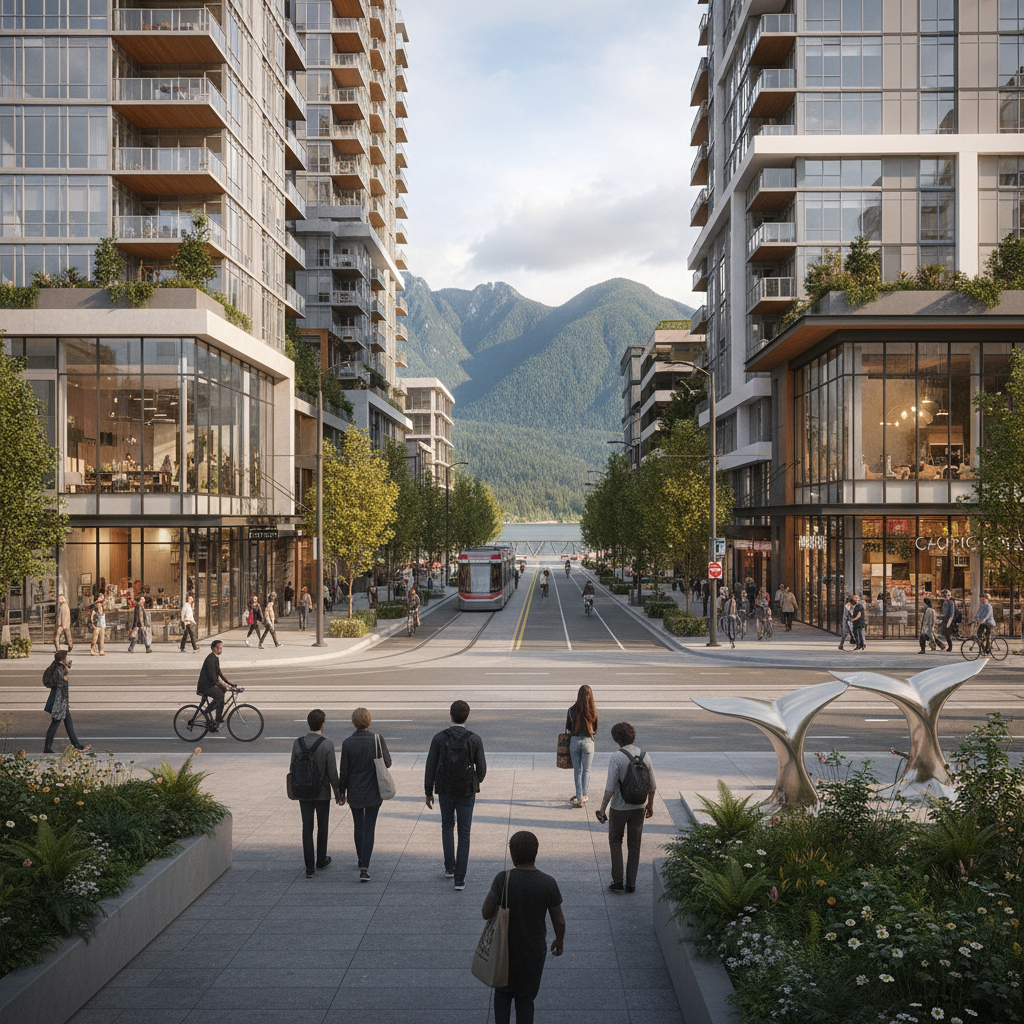
Additionally, zoning reforms in Vancouver and other municipalities are allowing for greater densification and mixed-use zoning. Under B.C.’s new provincial legislation introduced in late 2024, municipalities are incentivized to convert underutilized commercial parcels into transit-oriented communities — blending housing with retail and civic services.
The result is a gradual rebalancing: some traditional commercial zones may shrink, but they are being replaced by higher-value, mixed-use formats aligned with demographic and economic realities.
Investment Trends: Selectivity and Sustainability
Commercial real estate investment activity across B.C. slowed in 2023 and 2024 due to interest rate volatility, but early 2025 is showing signs of cautious optimism. Cap rates have adjusted upward across most property types, making acquisitions more viable for long-term investors.
Foreign and domestic institutional buyers remain active — particularly in industrial and purpose-built rental developments. Private investors are shifting toward suburban retail strips, healthcare properties, and small-bay industrial with steady cash flow and redevelopment upside.
Green buildings and ESG-compliant assets are drawing premiums. Vancouver remains a leader in green building certifications across Canada, and new commercial developments are increasingly net-zero ready.
“Capital is still flowing into British Columbia,” said Shailen Kumar, a real estate economist based in Burnaby. “But investors are more selective. They’re targeting assets that align with long-term demographic, environmental, and infrastructure trends.”
Regional Nuance: Beyond Metro Vancouver
While Metro Vancouver dominates headlines, other regions are playing a growing role in the province’s commercial recovery. In the Okanagan, Kelowna’s tech and healthcare sectors are fueling office absorption, while its tourism rebound is lifting hospitality investments.
On Vancouver Island, Victoria’s stable government-driven economy supports a healthy office and retail market, though industrial space remains tight. Nanaimo is emerging as a logistics hub thanks to ferry and port access.
Northern British Columbia, particularly Prince George and Terrace, is seeing increased interest from energy and logistics firms due to natural resource development and improved connectivity through Highway 16 and airport expansions.
Looking Ahead
British Columbia’s commercial real estate market in 2025 is not simply recovering — it’s repositioning. Shifting work models, demographic trends, and sustainability imperatives are transforming how and where people work, shop, and build. While some sectors like office are correcting, others — particularly industrial and mixed-use — are expanding strategically.
Municipal cooperation, infrastructure investment, and flexibility from developers will be key to sustaining recovery. In a high-cost, land-constrained province, success in commercial real estate hinges on balancing density, livability, and innovation.
As B.C. heads into the second half of the decade, the province’s enduring appeal — from global trade access to livable cities — remains intact. What’s changing is how real estate evolves to meet new expectations.