
- calendar_today August 20, 2025
A team from Carnegie Mellon University recently introduced LegoGPT, which is an advanced AI model capable of converting basic text instructions into stable Lego structures. The system stands out because it produces Lego designs from text descriptions and verifies that these creations can be assembled physically with human or robotic help. LegoGPT operates on the basic concept of transforming written descriptions like “a streamlined, elongated vessel” or “a classic-style car with a prominent front grille” into exact Lego brick arrangements that produce stable physical objects.
An autoregressive large language model trained on 47,000 physically stable Lego designs and their descriptive captions from OpenAI’s GPT-4o enabled the achievement. The training process allows the AI to understand how language correlates with stable Lego structures and enables the prediction of the next brick needed to sustain structural stability. LegoGPT applies foundational principles from large language models such as ChatGPT but shifts its predictive focus from “next-word prediction” to “next-brick prediction.”
The researchers improved Meta’s LLaMA-3.2-1 B-Instruct language model through fine-tuning and integrated it with a specialized software tool that uses mathematical models to assess gravity forces and structural integrity to validate the physical stability of generated designs. The “physics-aware rollback” feature stands out in LegoGPT as it monitors structural vulnerabilities throughout the design process to enhance stability through iterative redesigns by testing different brick positions, thus boosting stability rates from 24 percent to 98.8 percent.
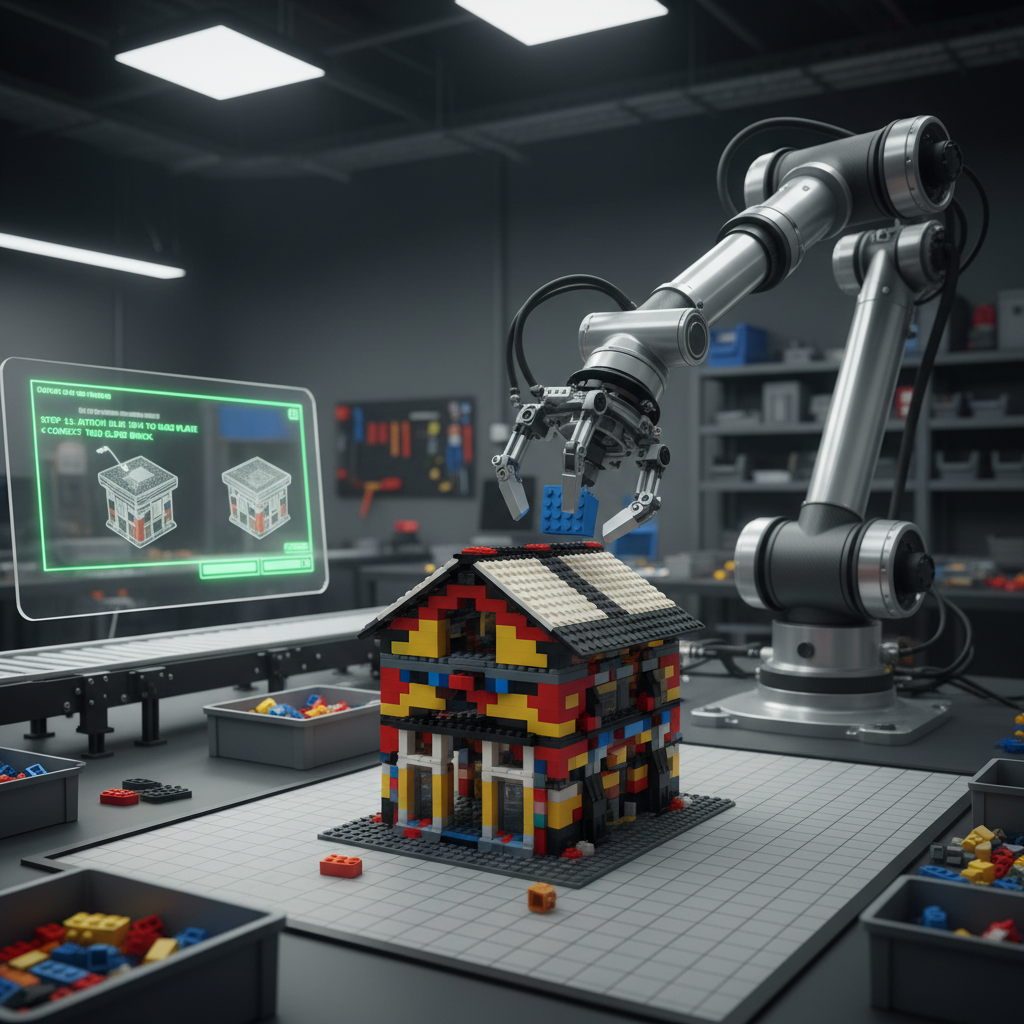
LegoGPT’s design validity in practical settings was tested through strict experimental procedures that included both robotic mechanisms and human builders. Researchers used a dual-robot arm system with force sensors to assemble AI-generated models by following specific brick sequences. Human testers joined the evaluation by manually constructing AI-designed Lego models, which confirmed that the LegoGPT system creates stable and buildable structures that match the original text descriptions. The test results confirmed that the system can convert written descriptions into Lego models, which display accurate design representation and maintain necessary structural strength for physical assembly. The fact that both robots and humans completed successful construction projects proves that the AI-generated building instructions are both practical and robust.
LegoGPT stands apart from other 3D creation AI systems like LLaMA-Mesh because it maintains a fundamental commitment to structural integrity. According to team evaluations, their method maintained greater structural stability than competing approaches that typically focus on visual appeal instead of physical practicality. The LegoGPT system functions within a specified building domain of 20×20×20 units and makes use of eight standard Lego brick varieties. Despite the current constraints, researchers have developed future development plans to enhance the system for larger designs with more complex structures that use diverse brick types, including slopes and tiles. The extension of system capabilities will probably require additional refinement of both the AI model and the physics simulation framework to manage the greater complexity.
The combination of natural language comprehension and physics simulation within LegoGPT has achieved a major advancement in AI-based design for construction tasks. The underlying principles and methodologies developed for LegoGPT demonstrate significant potential for application beyond toy design into fields such as architecture and engineering. Enabling abstract textual instructions to become physically realizable structures through a focus on stability and buildability demonstrates a significant transformation in practical AI design tools for tangible object creation. The ongoing evolution of AI will enable systems like LegoGPT to establish new standards for design and fabrication processes, which will make complex physical construction accessible to more industries.