
- calendar_today August 10, 2025
MJT fire chronicles: From smoke to restoration
Los Angeles’ Museum of Jurassic Technology (MJT) suffered a significant setback last month when a fire raged through the museum’s gift shop and caused major smoke damage to multiple exhibits. An estimated loss in income while the museum is closed could be as high as $75,000; the museum is hopeful that it will reopen sometime next month.
Situated in Culver City, the MJT is a decidedly unique and quirkily appealing element of LA’s cultural scene. Founded in 1988 by David Hildebrand Wilson and Diana Drake Wilson, the museum has gained notoriety and popularity for its intentionally confusing and sometimes-questionably factual exhibits. Claiming to be “dedicated to the advancement of knowledge and the public appreciation of the Lower Jurassic,” the MJT is misleading at best: its many curiosities do not belong to that geological period at all. Instead, the museum is built on a tradition of cabinets of curiosity, or wunderkammers, early collections of objects that contained the seeds of modern museums.
The MJT’s presentation and narrative layers and subversions are one of its more notable characteristics. Some of its exhibits, for example, are collections of authentic historical artifacts; others mix fact and fiction so completely that visitors are frequently uncertain as to what is real and what is fake. For instance, one of its long-time permanent exhibits is dedicated to the life and work of Athanasius Kircher, a real-life 17th-century German polymath, Jesuit priest, and Renaissance-era figure with an appetite for nearly all fields of knowledge. Another is focused on ultra-miniature sculptures by Hagop Sandaldjian, an Armenian-American artist who produced sculptures so tiny that they fit inside a needle’s eye and are made of single human hairs.
Many of the museum’s other collections take this quality even further, with twists and unexpected juxtapositions. One exhibit, for example, features decomposing dice once owned by magician Ricky Jay; another is a visual essay on trailer parks across the Los Angeles area, titled “The Garden of Eden on Wheels.” Stereographic radiographs of flowers, microscopic mosaics created from butterfly wing scales, and an eccentric collection of letters written to the Mount Wilson Observatory from amateur astronomers between 1915 and 1935 are some of the other exhibits. Since 2005, the museum has operated a Russian tea room as well, a replica of the study of Tsar Nicholas II of Russia in the Winter Palace in St. Petersburg.
Fire and Aftermath
In a thorough report on the fire, written by Lawrence Weschler, author of the 1996 Mr. Wilson’s Cabinet of Wonder—which investigates the origin and provenance of many of the MJT’s exhibits—the author details the response and rescue efforts of MJT’s founder and director, David Wilson. Wilson, who lives in a house behind the museum, was the first to discover the fire, noticing it coming from the building across the courtyard. He leapt up to the museum with two fire extinguishers and arrived in time to see “a ferocious column of flame” engulfing the corner of the building’s side that faces the street, a column that had quickly gone from “nine feet to 30 feet high in less than a minute,” according to Wilson.
The fire extinguishers he’d brought were, unfortunately, not up to the task of containing the fire. Fortunately for the museum, Wilson’s daughter and son-in-law had just arrived at the house and came running with a larger fire extinguisher that managed to put out the fire in time before the arrival of firefighters. The fire department later told Wilson that they’d likely have lost the entire building if they’d arrived one minute later.
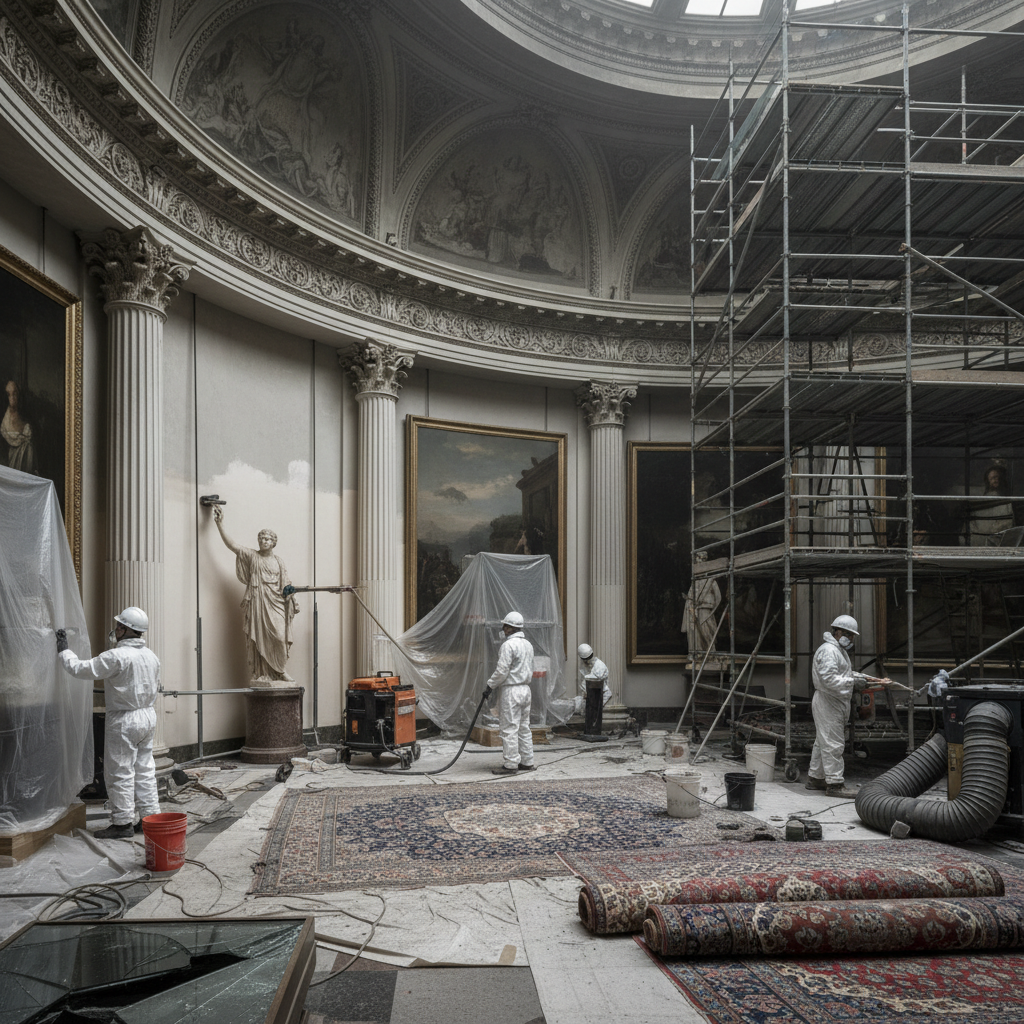
While the structural damage was limited to the gift shop, smoke damage affected the rest of the museum, a far more difficult clean-up than one might initially expect. Wilson likened the damage to “a thin creamy brown liquid… evenly poured over all the surfaces—the walls, the vitrines, the ceiling, the carpets, and eyepieces, everything.” Smoke damage is an especially serious and long process, and a major problem for a museum whose curiosities are as presentation- and detail-oriented as those of the MJT. Since the fire, the museum’s staff and volunteers have been working almost nonstop to clean and repair the damaged areas, a process that is slow and tedious.
In the interim, Weschler and other supporters have encouraged the museum’s benefactors to continue to support its general fund in order to help support lost revenue and clean-up, and repair operations. Weschler also noted that the MJT is “one of the most truly sublime institutions in the country, really one of the only genuine places of pilgrimage that American culture has yet come up with. It is sui generis, unique in its category, which is to say in no category at all: a place of dreamings and unearthly luminosities, not science, not art, not story.”
It is unclear when the museum will reopen, but there is confidence that the MJT will soon resume its mission of weirdness, knowledge, and institutional self-satire as usual.