
- calendar_today August 17, 2025
Google launched its seventh-generation Tensor Processing Unit (TPU) called Ironwood to push forward in artificial intelligence. Google’s custom-designed chip represents a significant advancement in hardware strategy by addressing the complex needs of its top-tier Gemini models beyond simple incremental improvements. Ironwood hardware is specifically engineered to perform well in simulated reasoning tasks termed “thinking” by Google, and it aims to trigger a transformative period for AI.
Ironwood’s Design and Purpose
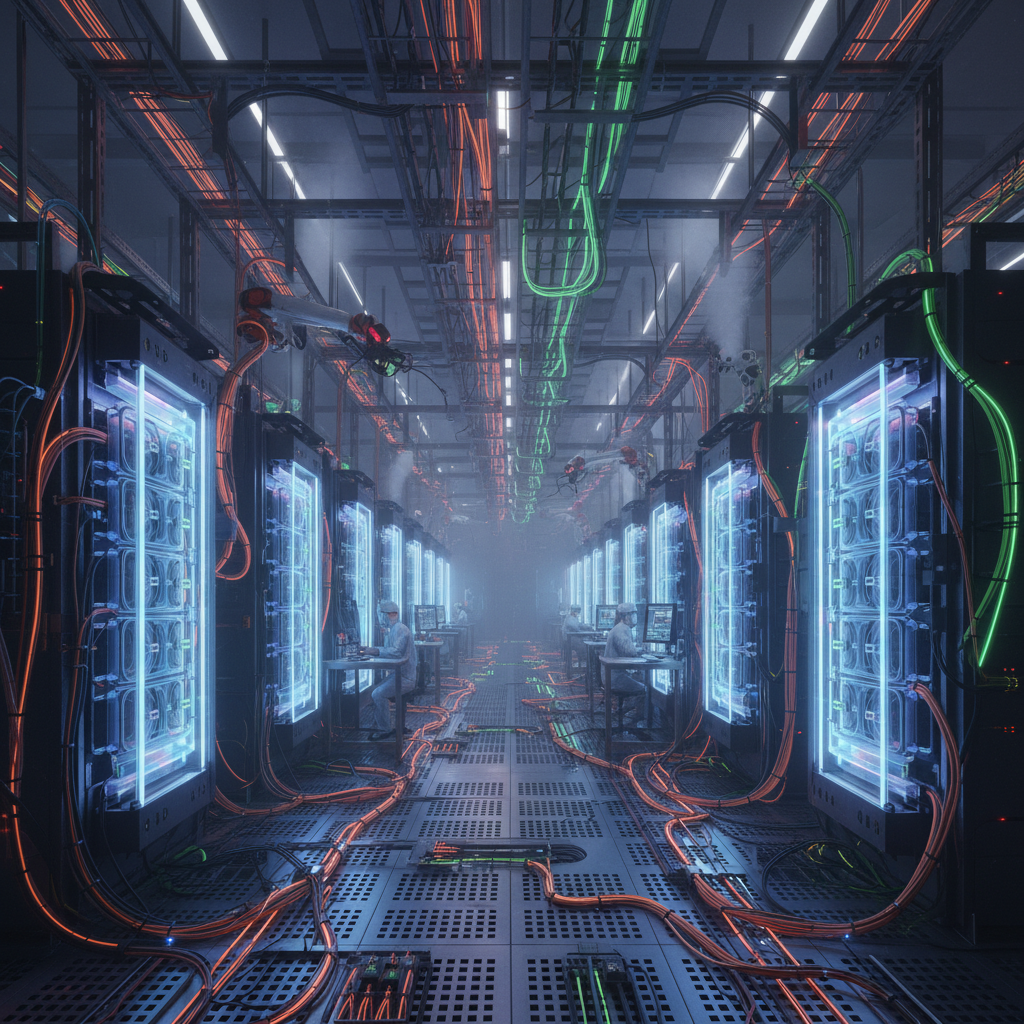
Ironwood achieves its capabilities through major improvements in performance coupled with advanced architectural design. Ironwood delivers far greater throughput than previous TPU generations while being specifically designed for deployment in expansive liquid-cooled cluster systems. The enhanced Inter-Chip Interconnect (ICI) provides efficient data exchange between the 9,216 individual chips within each cluster to enable high-speed communication. Google Cloud’s scalable architecture supports both internal research and development at Google and external developers through configurations that range from 256-chip servers to full 9,216-chip clusters.
Google’s Vision for AI
Google believes the increased speed and power efficiency, and greater memory capacity of Ironwood will have a transformative effect on its AI ecosystem, leading to major advancements. Ironwood’s strong computational support for advanced AI models promises significant advancements across multiple areas, such as natural language processing and machine learning, along with agentic AI development. The forthcoming generation of AI technology will function actively to independently collect data and use reasoning to take user-directed actions with minimal explicit instruction. Ironwood functions as a primary catalyst in Google’s mission to push AI technology into new frontiers.
The Driving Force Behind Ironwood
Google’s development of Ironwood demonstrates its belief in the fundamental connection between advanced AI models and specialized infrastructure. Google identifies Ironwood as an essential component in its strategic vision to increase AI inference speeds and broaden context window capabilities in order to unlock its defined “agentic AI” potential. The “age of inference” represents Google’s new paradigm, which imagines AI systems that take proactive actions to serve their users.
Ironwood’s Technical Specifications
The core specifications of Ironwood demonstrate its considerable computational strength. The fully equipped Ironwood pod reaches 42.5 Exaflops during inference computing operations. The peak throughput of each Ironwood chip reaches 4,614 TFLOPs which represents a major enhancement compared to earlier TPU generations. The new memory architecture in Ironwood enables support for its advanced processing capabilities. Ironwood’s chips contain 192GB of high-bandwidth memory which is six times larger than the memory found in Trillium TPU. The available memory bandwidth has expanded to 7.2 Tbps marking a 4.5 times improvement.
Benchmarking Ironwood
Google has published benchmarks to illustrate Ironwood’s performance where FP8 precision serves as the main measurement standard. The company declares Ironwood “pods” deliver 24 times faster performance than similar sections of leading supercomputers, but this statement requires careful assessment. Google admits that not all supercomputing systems have native support for FP8 precision, affecting how comparisons are made. Direct performance comparisons between the system and Google’s TPU v6 (Trillium) were absent from the report. According to Google, Ironwood delivers double the performance per watt compared to Trillium, which demonstrates its superior energy efficiency. According to a Google spokesperson, Ironwood succeeds TPU v5p and Trillium succeeds TPU v5e. The peak FP8 performance of Trillium reached about 918 TFLOPS.